What this covers
- Prepare the document fully before opening the print dialogue
- Number every page - a dropped unnumbered pack is unrecoverable
- Reading copies at two-up duplex, practice copies at full size
- One test page before a long job, always
A revision pack is several documents printed as one object: papers, mark schemes, reports, a condensed summary. Getting it right is almost entirely preparation, and the print dialogue is the last and least interesting part.
The preparation sequence
Ten minutes for a six-paper pack.
- Decide the order
Usually chronological for papers, with mark schemes either interleaved or grouped at the back. Interleaved is better for marking; grouped is better for resisting temptation.
- Delete what you will not use
Blank pages, cover sheets, duplicated inserts. On a scanned set this can be a third of the pages.
- Make the paper size uniform
If the sources disagree about A4 and Letter, resize the whole document to whatever is in the tray, with a 5 mm margin.
- Merge, with bookmarks
One file. Bookmarks name each source document, which is useful on screen and irrelevant on paper - do it anyway, because you will read this on a tablet too.
- Number every page
'X of Y', bottom centre unless the board already uses that corner. This is the step that matters most.
- Print one page and look at it
Not the first page. A page with a graph, or the busiest page in the pack.
The sequence in tools
Why numbering matters more than it sounds
A hundred-page pack, unnumbered, dropped on the floor. The papers are distinguishable from each other but the pages within each are not, and there is no way to reconstruct the order except by reading every page. 'Paper 2 - 14 of 32' makes it a two-minute job.
Reading copies and practice copies are different jobs
This is the decision that determines how much paper you use. A reading copy - a mark scheme, an examiner report, a condensed summary - can go two pages per sheet, double-sided, in greyscale. That is a quarter of the paper and about a quarter of the cost.
A practice copy - a paper you will sit under timed conditions - has to be full size, one page per sheet, at 100 per cent scale, because you need the answer space and because anything measured on the page has to be the right size.
What to print how
Per section of the pack.
| Section | Layout | Colour | Why |
|---|---|---|---|
| Question paper for timed practice | One page per sheet, 100% | Greyscale unless colour carries meaning | Answer space and measured accuracy |
| Mark scheme | Two-up, duplex | Greyscale | Read, not written on |
| Examiner report | Two-up, duplex | Greyscale | Read once, carefully |
| Condensed summary | One page per sheet | Greyscale | You will annotate it |
| Anything with a colour-coded diagram | One page per sheet | Colour | The colour is the content |
Crop before printing two-up
Two A4 pages on one A4 sheet means each is at about 70 per cent, and the margins come along for the ride. Cropping the margins off first means the text fills the reduced area rather than the white space doing so.
It is the difference between a two-up mark scheme that is comfortable to read and one that is technically legible.
A six-paper pack, measured
- Full size, single-sided, everything
- 248 sheets
- Reading sections two-up duplex
- 96 sheets
- After deleting blanks and cover sheets
- 81 sheets
- Preparation time
- About ten minutes
- Greyscale rather than colour
- Roughly half the consumable cost
The test page
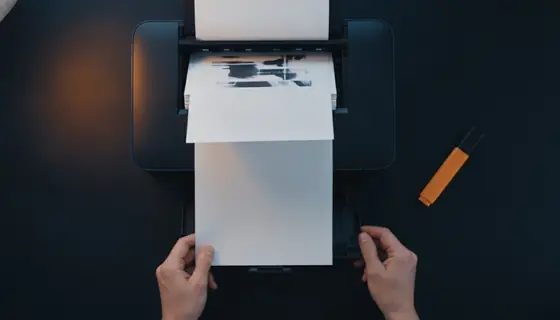
Print one page before committing the job, and choose it deliberately: the busiest page, or one with a graph. The first page of a document is usually a cover and tells you nothing.
What you are checking is whether the scale is right, whether the numbering collides with anything, whether the greyscale conversion has destroyed a colour-coded diagram, and whether anything is clipped at the edges. All four are invisible on screen and obvious on paper.
Before the job runs
- Blank pages and cover sheets deleted
- Paper size uniform across the whole document
- Merged in the order you will use it
- Every page numbered, 'X of Y', in an empty corner
- Reading sections cropped if they will print two-up
- Scale set to 100 per cent for anything measured
- One test page printed, from the middle of the document
Questions and answers
Should mark schemes be in the same printed pack as the papers?
If you can resist reading ahead, interleaving is convenient for marking. Most people cannot, so printing them as a separate stack and keeping it in a different place works better.
Is two pages per sheet readable?
For reading, yes, particularly if you crop the margins first. For anything you will write on or measure, no.
How do I stop the page numbers colliding with the board's own?
Choose a different corner. Many boards use bottom right for their own numbering, so bottom centre is usually clear. Check the test page.
Is it worth printing at all, when I have a tablet?
For timed practice, yes. Writing on the paper, turning pages and working in the space provided are all part of what you are rehearsing, and a tablet reproduces none of them.