What this covers
- A4: 210 x 297 mm. Letter: 216 x 279 mm
- Letter is wider and shorter, so neither fits inside the other
- Mismatches are resolved by the driver, differently on each printer
- Resize the document before printing rather than letting the driver decide
Almost everywhere in the world, standard paper is A4. In the United States and Canada, it is Letter. The difference is small enough to be invisible until you print something, and large enough that neither fits inside the other.
The dimensions
A4 is 210 by 297 millimetres. US Letter is 8.5 by 11 inches, which is 215.9 by 279.4 millimetres.
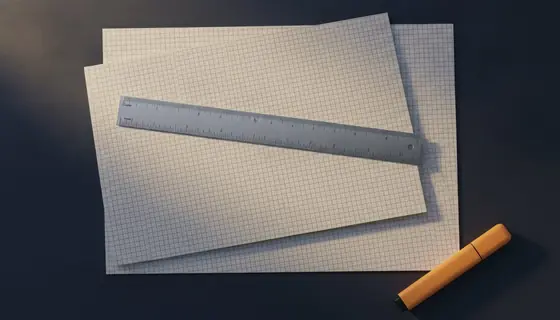
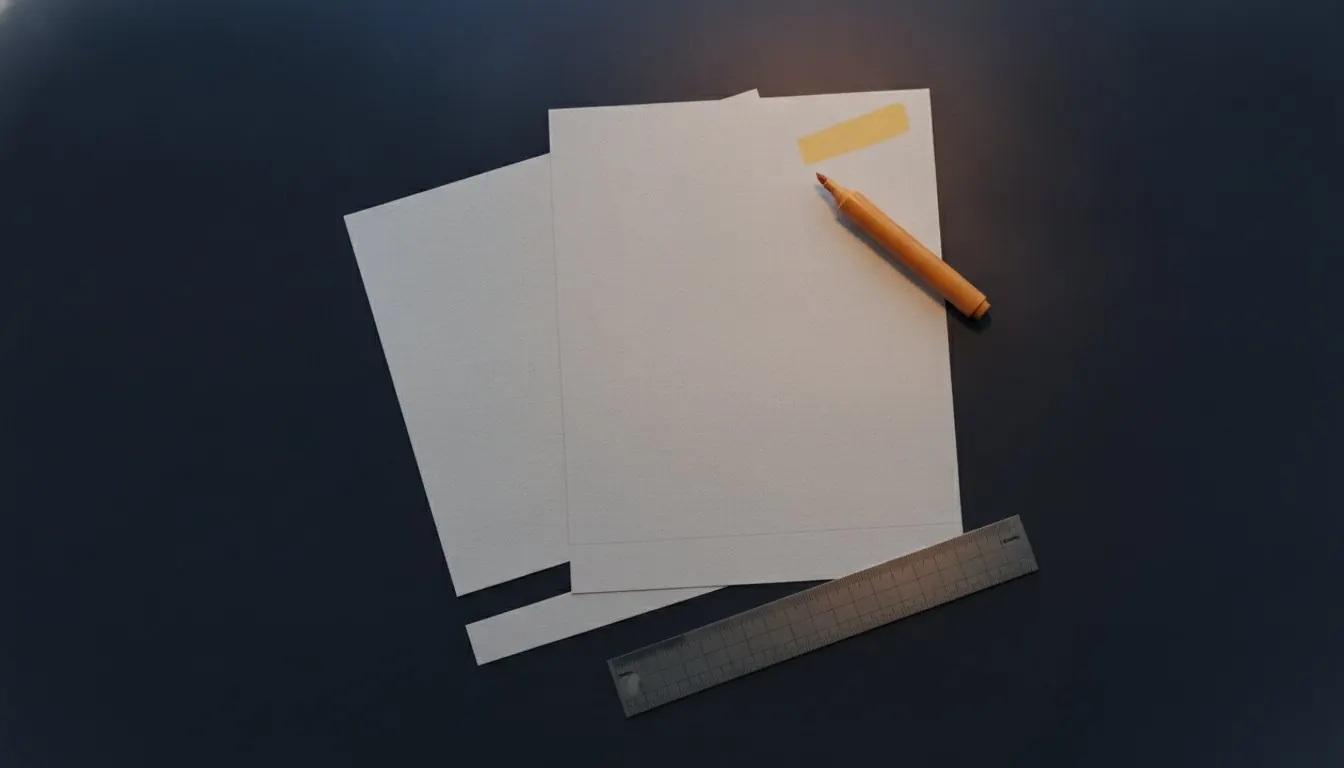
Letter is about 6 millimetres wider and about 18 millimetres shorter. Because it is wider in one direction and shorter in the other, there is no orientation in which one fits inside the other without either clipping or scaling. That is the whole problem, and it is why it cannot be solved by turning the paper round.
Side by side
The numbers that matter.
| A4 | US Letter | Difference | |
|---|---|---|---|
| Width | 210 mm | 215.9 mm | Letter is 5.9 mm wider |
| Height | 297 mm | 279.4 mm | Letter is 17.6 mm shorter |
| Aspect ratio | 1:1.414 | 1:1.294 | A4 is noticeably taller in proportion |
| Area | 62,370 mm² | 60,325 mm² | A4 is about 3 per cent larger |
| Used in | Most of the world | US, Canada, parts of Latin America |
Why A4 has that ratio
A4's proportions are the square root of two to one, which has a useful property: fold an A4 sheet in half and you get two sheets of exactly the same proportions, which is A5. The whole A series works this way, which is why enlarging A4 to A3 or printing two A5 pages on one A4 sheet needs no adjustment at all.
Letter has no such relationship to any other size. It is an inch-based convention, and two Letter sheets side by side are not a Letter sheet at any scale.
The real-world symptom
A revision pack merged from an international source and a domestic one contains both sizes. Printed as one job, some pages come out with different margins, the stack does not align when stapled, and on some printers the job pauses to ask about paper. All from six millimetres.
What a driver does with a mismatch
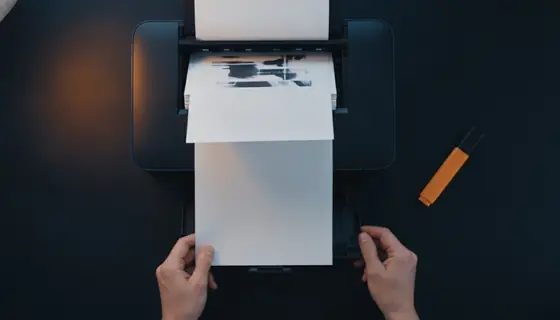
It varies, which is the difficulty. Asked to print an A4 document on Letter paper, a driver may scale the page down to fit, print at full size and clip the bottom 18 millimetres, or centre the page and clip evenly at top and bottom.
All three are reasonable behaviours and all three are different. Since the scaling amount also differs by printer, a document that prints acceptably in one place prints wrongly in another, and neither printout tells you what happened.
Making a mixed document print consistently
Five minutes for a whole pack.
- Find out what you have
The reader reports the page size of a document. In a merged pack, check the first page of each section.
- Choose the paper you actually have
A4 outside North America, Letter inside it. There is no point resizing to A4 if the tray holds Letter.
- Resize the whole document to that size
With a 5 mm margin, which keeps content clear of the printer's unprintable edge.
- Print at 100 per cent
The document and the paper now agree, so there is nothing for the driver to decide.
Making the sizes agree
What resizing costs
Resizing scales each page proportionally onto the new sheet and centres it, so nothing is stretched and nothing is clipped. Text and vector content scale cleanly. Images are resampled.
The real cost is that links, bookmarks and interactive form fields are not carried across, because each page is redrawn onto a new sheet. If those matter more than uniform paper, do not resize - print the sections separately instead, each on its own paper size.
For measured work, use the right paper
Any conversion between the two sizes scales the content by about six per cent, which invalidates anything you measure on the page. For a graph question that matters.
If you are in a Letter country and working from A4 exam material, this is worth taking seriously: either obtain A4 paper for the papers you will measure on, or accept that measured answers will be systematically off and work the questions on screen instead.
Quick reference
- A4
- 210 x 297 mm / 8.27 x 11.69 in
- US Letter
- 215.9 x 279.4 mm / 8.5 x 11 in
- US Legal
- 215.9 x 355.6 mm / 8.5 x 14 in
- A3
- 297 x 420 mm - exactly two A4 sheets
- A5
- 148 x 210 mm - exactly half an A4 sheet
- Scaling A4 onto Letter
- About 94 per cent
Printing a document from elsewhere
- Check the document's page size in a reader
- Check what is actually in the printer tray
- Resize the document if they disagree, with a 5 mm margin
- Print at 100 per cent once they agree
- For anything you will measure, use the paper the document was designed for
Questions and answers
Can I just print A4 on Letter paper?
You can, and the driver will scale or clip it by an amount that varies between printers. For prose that is fine. For anything measured, resize the document deliberately first, or use A4 paper.
Which is bigger?
Neither, consistently. Letter is 6 mm wider, A4 is 18 mm taller. A4 has about 3 per cent more area, and neither fits inside the other.
Why do my merged papers print with different margins?
Because the sections came from sources that used different paper sizes. Resize the whole document to one size before printing.
Does resizing lose quality?
Text and vector content scale cleanly at any size. Images are resampled, so scaling a low-resolution scan up will show it. Links and form fields are lost, because each page is redrawn.
Sources
- ISO 216 - Writing paper and certain classes of printed matterA-series dimensions